Ultimate Guide for Modern Outlook Versions
In the modern professional landscape,seamless email communication is a must. Microsoft Outlook remains one of the choices for smooth corporate correspondence. Besides emailing,the app offers various personal information storage features,including tasks,journals,calendars,and contacts. Also,Outlook is known as a PIM- Personal Information Manager.
Over time,Outlook has upgraded its versions to provide the best user experience. The most common file format of Outlook is PST,which supports ANSI and Unicode filesaving methods. The latest versions of Outlook create Unicode versions,whereas Outlook 2002 saves data in ANSI.
Understanding ANSI vs Unicode PST Formats
The older ANSI format features a strict data storage threshold of 2 GB. While this capacity can be used for personal use,it falls short in professional environments. Exceeding the limit makes Outlook slow and increases the risk of file corruption. It is therefore,the PST Unicode format has been introduced,which has a storage capacity of 20GB to 50 GB. It has brought lots of differences in working pattern with ANSI and Unicode.
Unicode:The Modern Era PST Format
Unicode is a modern PST format that comes with backward support,allowing users to access data on previous versions of Outlook. Though,the support has limits of only opening and reading such PST files. If you need to actively edit or modify a modern Unicode PST file within a legacy version of Outlook,you must save or convert that data into an ANSI-supported structure.
Creating the ANSI PST File
Step 1:Click on the New Items and select More Items.
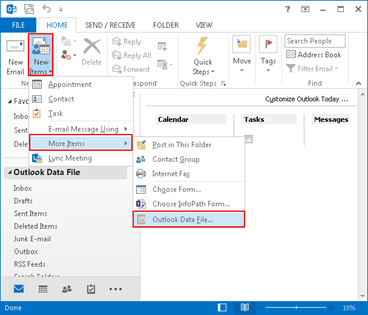
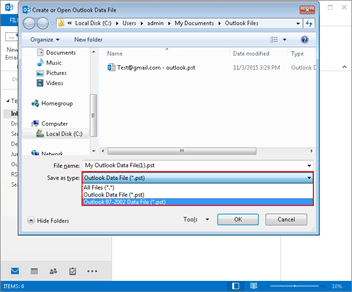
Step 2:Click the Save as type and choose Outlook Data File.
If you are facing the 2 GB limit of a legacy file and need to convert it upward into a spacious Unicode file,manual exporting can be incredibly slow and carries a risk of data loss. Using a dedicated professional utility like the Softaken PST Upgrade Toolensures a swift,batch conversion without risking data loss.